
Website Design and Local SEO Strategies for Sunshine Coast Businesses
Table of Contents
The Sunshine Coast is one of Queensland’s fastest-growing business regions and that growth has completely changed how local customers find and choose the businesses they buy from. Fewer people are browsing directories or driving past shopfronts to compare options. Almost everyone starts with a Google search on their phone, standing in their kitchen or sitting in their car, ready to book, call, or buy within minutes. If your website isn’t built for that moment, and your business isn’t optimised for local search, you’re losing customers to competitors who are.
Why Local Search Visibility Matters for Sunshine Coast Businesses
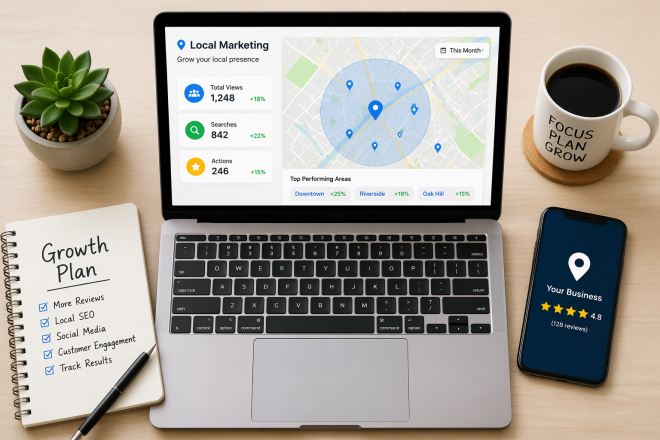
Construction alone makes up 21.5% of all registered businesses on the Sunshine Coast, well above the Queensland average of 17%. Add growing competition across trades, health services, hospitality, tourism, and retail, and it’s clear: whatever industry you’re in, more local competitors are fighting for the same searches every year. The region has also been named among the strongest small business growth areas in Queensland, alongside places like Ipswich and Logan — which means the businesses that were easy to find two years ago are now competing against a wave of newcomers.
Local search visibility showing up in Google’s map pack and local organic results determines who gets found first. This isn’t just a nice-to-have anymore; it’s the primary way most residential and visiting customers discover a business. A smaller operator with strong local SEO can regularly outrank a bigger, better-funded competitor who’s neglected theirs. This is the single biggest opportunity most Sunshine Coast business owners are leaving on the table.
Consider two hypothetical businesses: a family-run electrical business we’ll call Coastal Spark Electrical, and a larger, longer-established competitor with a much bigger advertising budget. If Coastal Spark has a fast, mobile-friendly website, a fully completed Google Business Profile, and a steady flow of reviews from Buderim and Mooloolaba customers, it can regularly outrank the bigger competitor for searches like “electrician Buderim” simply because it’s better optimised for how people actually search locally. Local SEO rewards precision and consistency, not just size or budget.
Understanding How Local Search Actually Works
Before diving into tactics, it helps to understand what Google is actually trying to do. When someone searches “cafe near me” or “physio Noosa,” Google’s algorithm weighs three main factors: relevance (does this business match what’s being searched for), distance (how close is it to the searcher or the specified location), and prominence (how well-known and well-reviewed is the business, both online and offline).
This is why a business with excellent service but a thin online presence can be outranked by a newer, smaller competitor that’s simply done a better job signalling relevance and prominence to Google. It’s also why local SEO isn’t a single task you complete once it’s an ongoing combination of website quality, consistent business information, and genuine community reputation.
Mobile-First Web Design for Local Customers
Most local searches “plumber Maroochydore,” “cafe near me Noosa,” “vet Caloundra” happen on mobile devices, often while someone is out and about and ready to act quickly. If your site is slow to load, hard to navigate on a small screen, or doesn’t make your phone number and location obvious within seconds, you lose that customer to the next result down.
Mobile-first design means:
- Pages that load in under 2–3 seconds on mobile data
- Click-to-call phone numbers and clear location details above the fold
- Simple navigation with minimal menu depth customers shouldn’t need more than two taps to find your services or contact details
- Legible text and tap-friendly buttons without zooming or pinching
- Booking or enquiry forms that are short and simple to complete on a small screen
Google also uses mobile-first indexing, meaning it primarily evaluates the mobile version of your site when deciding how to rank you not the desktop version. A beautiful desktop site with a clunky mobile experience will still underperform in search results.
Example: Imagine a fictional beachside café, Driftwood Kitchen in Mooloolaba. A visitor searching “breakfast near me” on their phone wants to see the menu, opening hours, and a map within seconds not pinch-zoom through a desktop-style layout. A mobile-first redesign focused on exactly that journey (menu, hours, location, one-tap directions) typically lifts both time-on-site and walk-in conversions.
Google Business Profile Optimisation
For most local businesses, a Google Business Profile (formerly Google My Business) is the very first thing a potential customer sees often before they ever click through to your website. A fully optimised profile includes:
- Accurate business name, address, and phone number (NAP)
- Correct primary and secondary categories that reflect exactly what you offer
- Defined service areas covering your actual Sunshine Coast suburbs, not just your physical address
- Regularly updated photos of your premises, team, products, or completed work
- Weekly or fortnightly Google Posts sharing updates, offers, or projects
- A steady stream of genuine, recent customer reviews
- Prompt, professional responses to every review both positive and negative
Businesses with complete, active profiles are significantly more likely to appear in the map pack, the three-listing block that shows up above organic results for local searches often the single highest-converting piece of real estate on the entire results page.
Example: A fictional local business, Sunshine Coast Physio Group, operating across two clinics in Maroochydore and Buderim, could set up separate, fully optimised Google Business Profiles for each location rather than one generic profile. Each listing targets its own suburb, collects its own local reviews, and appears independently in map pack results for searches in both areas effectively doubling the business’s local visibility footprint.
On-Page SEO and Location-Specific Content
Generic website copy that could apply to a business anywhere in Australia does nothing to help you rank for Sunshine Coast searches. On-page SEO means building content that’s specific to where you actually operate:
- Dedicated pages or sections for each suburb or service area you cover (Maroochydore, Caloundra, Noosa, Buderim, Nambour, Mooloolaba, and so on)
- Page titles and headings that naturally include your service and location, written for humans first
- Locally relevant content — mentioning local landmarks, events, seasonal conditions, or community context where genuine and useful
- Descriptive alt text on images, especially for location or project photos
- Internal links connecting related service pages together, so both customers and search engines can navigate your site logically
The goal isn’t to stuff keywords in it’s to make it unmistakably clear to both Google and your visitors exactly what you do and where you do it. A tree removal business, for example, benefits far more from a page titled “Tree Removal Services in Buderim and the Hinterland” with genuine local detail than from a single generic “Our Services” page trying to cover the entire Sunshine Coast at once.
Example: A landscaping business, Hinterland Grounds Co, could build out individual pages for “Landscaping Buderim,” “Landscaping Maleny,” and “Landscaping Montville” each with photos of actual completed local projects, references to local soil or climate conditions, and location-specific customer testimonials. This kind of granular, suburb-by-suburb content consistently outperforms one broad, unfocused services page in local search results.
NAP Consistency and Local Citations
NAP consistency keeping your Name, Address, and Phone number identical across every online listing is a ranking factor that’s easy to overlook and costly to ignore. Inconsistent details across your website, Google Business Profile, Facebook page, and directories like True Local, Yellow Pages, Yelp, or Hotfrog send confusing signals to search engines and can quietly suppress your rankings.
This matters even more for businesses that have rebranded, moved premises, or changed phone numbers. A fictional example: if Coastal Roofing Solutions changed its business name a few years ago from “Coastal Roofing Repairs,” but old directory listings, an outdated Facebook page, or an abandoned business listing still reference the previous name or an old phone number, Google may struggle to confidently associate all those signals with the same, currently active business diluting the authority it should be building.
A local citation audit checking and correcting your business details across all major directories is one of the highest-ROI, lowest-effort local SEO tasks a Sunshine Coast business can do. It typically takes a few hours to complete and can meaningfully improve rankings within weeks.
The Role of Your Local Business Name in Local SEO
Your business name plays a bigger role in local SEO than most owners realise — and it cuts both ways. A clear, locally relevant, and consistently used business name helps customers recognise and trust you, and helps Google confidently match your business to relevant local searches. A business name that’s vague, frequently changed, or inconsistently written across platforms actively works against your rankings.
A few principles worth applying:
- Use your real, registered business name consistently everywhere: your website, Google Business Profile, social media, invoices, and directory listings should all use the exact same name, spelling, and punctuation. Even small inconsistencies (using “&” in one place and “and” in another, or dropping “Pty Ltd” inconsistently) can create confusion for local search algorithms.
- Avoid keyword-stuffing your business name. Adding extra suburb names or service keywords to your official Google Business Profile name that aren’t part of your real, legally registered name violates Google’s guidelines and risks suspension of your listing entirely.
- A locally recognisable name builds prominence over time. A name like Sunshine Coast Dental Studio or Noosa Trades Co builds a stronger local association in customers’ minds and in search engines’ understanding of your relevance to the region than a generic or geographically ambiguous name might.
- If you operate under a trading name, register it properly and use it consistently, so directories and citations don’t end up split between your legal entity name and your trading name.
Getting this right doesn’t require a rebrand. It simply means auditing where your business name currently appears online, fixing inconsistencies, and making sure every new listing, partnership, or piece of marketing collateral uses the same, correct version going forward.
Building Local Backlinks and Community Authority
Search engines treat links from other reputable websites as a vote of confidence. For local businesses, the most valuable links often come from within the community itself:
- Local business associations and Chambers of Commerce
- Sunshine Coast Council business directories and initiatives
- Local news outlets, community blogs, and event sponsorships
- Partnerships and supplier relationships with other local businesses, with links exchanged where genuinely relevant
- Local sporting clubs or community groups you sponsor
These links don’t just support rankings they reinforce that your business is a genuine, established part of the local community, which matters to both customers and search algorithms. A fictional example: a local sports physiotherapy clinic sponsoring a junior football club on the Coast might earn a link from the club’s website and local sporting association listings modest individually, but meaningful in aggregate, and entirely authentic rather than manufactured.
Content Marketing That Supports Local SEO
Search engines treat links from other reputable websites as a vote of confidence. For local businesses, the most valuable links often come from within the community itself:
- Local business associations and Chambers of Commerce
- Sunshine Coast Council business directories and initiatives
- Local news outlets, community blogs, and event sponsorships
- Partnerships and supplier relationships with other local businesses, with links exchanged where genuinely relevant
- Local sporting clubs or community groups you sponsor
These links don’t just support rankings they reinforce that your business is a genuine, established part of the local community, which matters to both customers and search algorithms. A fictional example: a local sports physiotherapy clinic sponsoring a junior football club on the Coast might earn a link from the club’s website and local sporting association listings modest individually, but meaningful in aggregate, and entirely authentic rather than manufactured.
Website Speed, Core Web Vitals, and Technical SEO
Beyond mobile-friendliness, Google evaluates a set of technical performance measures known as Core Web Vitals, how quickly your page loads, how soon it becomes interactive, and how visually stable it is while loading. Poor scores here can hold back even well-designed, content-rich websites.
Technical foundations worth checking regularly:
- Image compression and modern file formats (WebP over large PNGs or JPEGs)
- Clean, secure hosting (HTTPS) with reliable uptime
- A logical site structure with an up-to-date XML sitemap submitted to Google Search Console
- No broken links or outdated redirect chains
- Schema markup for local businesses, helping search engines understand your services, hours, location, and reviews in a structured format
- Minimal use of heavy, unnecessary scripts or plugins that slow page load
Many Sunshine Coast businesses are still running on website platforms or themes that were fine five years ago but weren’t built with today’s mobile speed expectations in mind. A technical audit is often the fastest way to identify quick wins that improve both user experience and rankings.
Competitor Analysis: Learning From What's Already Working Locally
One of the most underused local SEO tactics is simply studying who’s already ranking well for your target searches. Looking at the businesses currently appearing in the map pack for terms relevant to your industry can reveal exactly what Google is rewarding in your specific local market the number and recency of their reviews, the depth of their service pages, how they’ve structured their Google Business Profile categories, and where their backlinks are coming from.
This isn’t about copying a competitor’s website. It’s about identifying the baseline you need to beat. If every top-ranking competitor for “boat repairs Mooloolaba” has 50-plus recent reviews and dedicated service pages, a business with five reviews and a single homepage is unlikely to compete until it closes that gap.
Tracking Results and Ongoing SEO Maintenance
Local SEO isn’t a set-and-forget project. Search rankings shift as competitors improve their own sites, as Google updates its algorithm, and as your business changes. Sunshine Coast businesses that see sustained results typically track:
- Local map pack rankings for target keywords and suburbs
- Website traffic from organic and local search, and which pages it’s landing on
- Google Business Profile views, calls, direction requests, and website clicks
- Conversion rate from website visits to enquiries, bookings, or phone calls
- New review volume and average rating over time
Reviewing this data monthly makes it possible to catch drops in visibility early, understand which suburb-specific pages are actually performing, and keep refining what’s working rather than guessing.
Common Mistakes Sunshine Coast Businesses Make
A few patterns show up repeatedly when auditing local Sunshine Coast websites and search presences:
- Treating the website as a digital brochure rather than a lead-generation tool, with no clear calls to action or easy way to contact the business
- Letting the Google Business Profile go stale — outdated hours, no recent photos, unanswered reviews
- Using one generic “Sunshine Coast” service page instead of suburb-specific content
- Inconsistent business name, address, or phone details across directories, often left over from a past rebrand or office move
- Ignoring mobile performance because the site looks fine on the owner’s office desktop
- No system for requesting reviews, leaving review volume to chance rather than a consistent process
Most of these are fixable without a full rebuild they just require a proper audit and a plan to address them systematically.
Bringing It All Together
Strong website design and local SEO aren’t separate projects — they work together. A fast, mobile-friendly site gives customers a good experience once they find you; local SEO is what gets you found in the first place. A Sunshine Coast business investing in both is building a genuine, compounding competitive advantage — the kind that gets harder for competitors to catch up to the longer it’s left unaddressed.
With local business numbers continuing to grow across construction, trades, health, hospitality, and tourism, the businesses moving on this now are the ones positioning themselves to capture that demand. The ones waiting are handing it to whoever gets there first.
FAQs
How long does local SEO take to show results for a Sunshine Coast business?
Most businesses start seeing measurable movement in local rankings within 3 to 6 months, with stronger, more stable results building over 6 to 12 months. Timelines depend on how competitive your industry and suburb are, how much work your existing website and listings need, and how consistently the strategy is maintained.
Do I need a new website, or can local SEO work with my current site?
It depends on your current site’s condition. If it’s mobile-friendly, reasonably fast, and technically sound, local SEO can often be layered on top through content, citations, and Google Business Profile work. If it’s slow, outdated, or hard to navigate on mobile, a redesign will usually deliver better and faster results than trying to optimise around those limitations.
How important are Google reviews for local SEO?
Very important. Reviews influence both your local search rankings and whether potential customers choose to click through and contact you over a competitor. A steady flow of genuine, recent reviews along with thoughtful responses to each signals trust to both customers and Google, and recency matters as much as total volume.
What's the difference between local SEO and regular SEO?
Regular SEO focuses on ranking for broader, often national or global search terms. Local SEO specifically targets searches with local intent “near me” searches, suburb-specific queries, and the Google map pack and relies heavily on factors like Google Business Profile completeness, local citations, NAP consistency, and location-specific content.
Should my business target the whole Sunshine Coast or specific suburbs?
In most cases, specific suburbs perform better. Targeting “Maroochydore,” “Caloundra,” or “Noosa” individually, with content, citations, and reviews tailored to each, tends to outperform trying to rank broadly for “Sunshine Coast” alone especially for service-area businesses covering multiple towns.